Grants & Projects
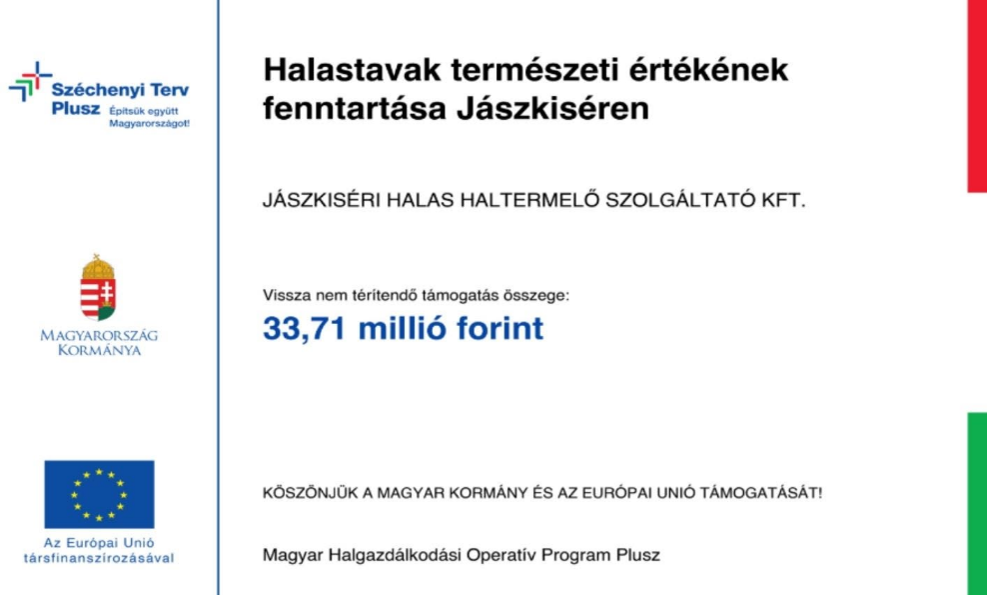
Detailed Presentation of the Project Content
Our primary goal during the project is to maintain valuable aquatic ecosystems. We design our production system accordingly. When carrying out our technological processes, we take into account the nesting and feeding habits of the species living here in the following areas.
The extensive type of farming provides more undisturbed conditions for the aquatic ecosystem living here. In line with our technology, our fish ponds are harvested every year through full drainage. During the nesting period (March 1 – July 15), the prescribed daily water level fluctuation may not exceed 5 cm. Our flooding capacity also does not allow the prescribed limits to be exceeded.
During the winter period, we do not place any technical barriers/fences/long underground pipe sections in the feeder and drainage channels directly connected to the fish pond that would obstruct the movement and feeding of otters. Our fish ponds provide artificially maintained wetland habitats in areas that are drying out due to climate change, and offer resting and feeding grounds for migratory waterfowl species. They maintain suitable living space for protected species such as the pygmy cormorant (Phalacrocorax pygmaeus), Eurasian spoonbill (Platalea leucorodia), pied avocet (Recurvirostra avosetta), ferruginous duck (Aythya nyroca), Eurasian bittern (Botaurus stellaris), little bittern (Ixobrychus minutus), black-crowned night heron (Nycticorax nycticorax), squacco heron (Ardeola ralloides), little egret (Egretta garzetta), great egret (Egretta alba), black-winged stilt (Himantopus himantopus), common tern (Sterna hirundo), black tern (Chlidonias niger), European pond turtle (Emys orbicularis), and European otter (Lutra lutra). Within a 100-meter radius of the nesting colonies of colonially nesting waterfowl, we preserve the aquatic vegetation and do not carry out any reed/weed thinning. We only carry out bird deterrence during the period in which it may be conducted without a permit.
By observing all of these measures, we are able to maintain a natural value far greater than the value of fish production itself.
Planned completion date of the project: December 31, 2027.
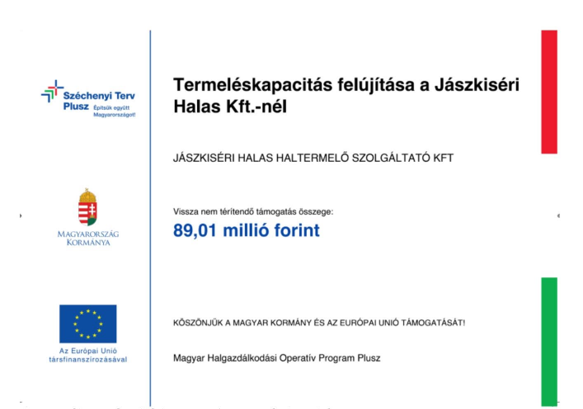
Jászkiséri Halas Kft.'s Production Capacity Is Being Renewed
Jászkiséri Halas Kft. has launched its project entitled "Renewal of Production Capacity at Jászkiséri Halas Kft." The investment is being carried out under call code MAHOP PLUSZ-2.1.1-2025, "Support for Aquaculture Investment," co-financed by the European Union and the Hungarian State.
Project Overview
The aim of the development is to modernize the aging infrastructure and technology of the 185-hectare pond farm. With the help of the HUF 89.01 million non-repayable grant, the company will carry out the following developments:
Infrastructural reconstruction: Renovation of the wintering system built in the 1970s and the outdoor fish beds to enable more efficient harvesting and sales.
Environmental protection and animal welfare: Sediment removal, slope protection, and restoration of the condition specified in the water rights permit to improve animal health conditions.
Technological modernization: The electrical network will be renewed, a new, controllable pump will support energy-efficient water use, and modern production equipment will be acquired.
Working conditions and transparency: In addition to air conditioning the social building, a new, accessible website will ensure the public visibility of the project.
Planned project completion date: August 31, 2026.